Version 1.1 now on the App Store
Blood pressure, glucose, weight, oxygen, peak flow, medicines with reminders, fluid and symptoms, and now food, alcohol, exercise and mindfulness. One PDF summary for your next appointment. Nothing leaves your iPhone.
The record
Patients who arrive with their numbers written down get more out of every appointment. Patient Diary keeps the numbers, the medicines and the diary together, and turns any 7, 14, 30 or 90 day window into a PDF you can hand to your GP or specialist.
Blood pressure and pulse with the category shown, glucose and insulin in mmol/L or mg/dL, weight in kg, stone or lbs, oxygen saturation and peak flow with green, amber and red zones.
Your medication list with up to four reminder times a day, dose and notes, and a flag for the medicines that cannot be missed, such as transplant immunosuppression, so the reminder stands out.
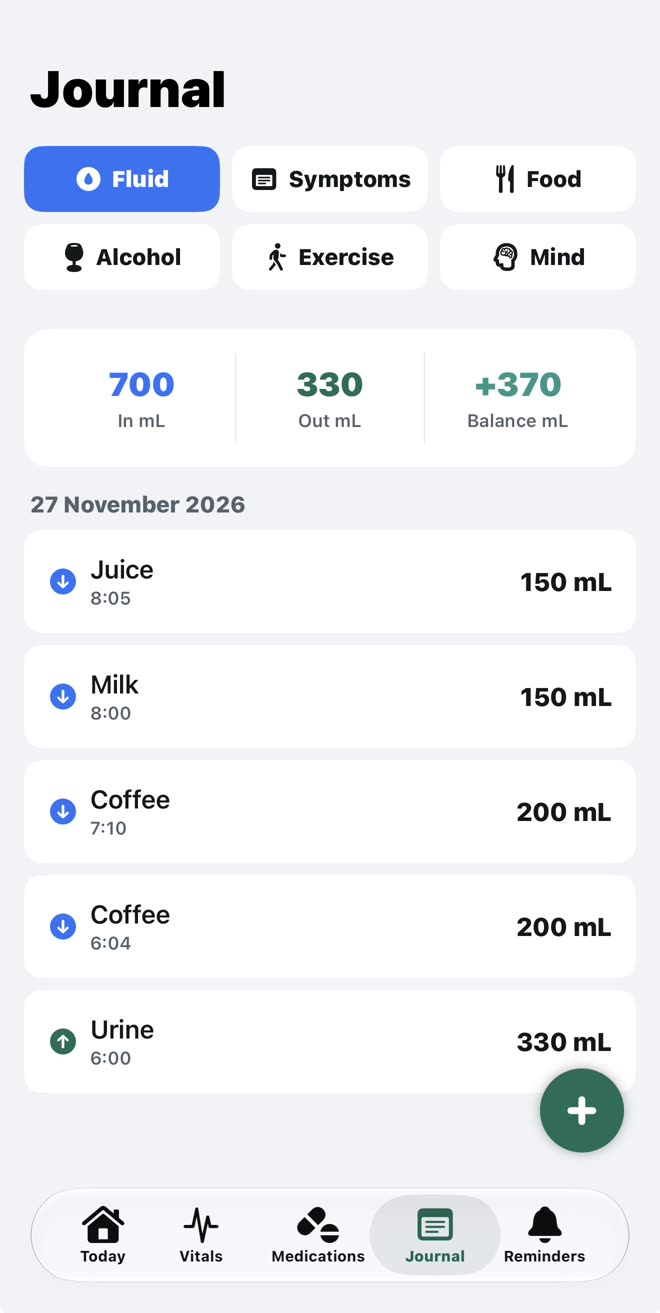
Fluid in and out with the running balance, and a symptom diary scored from one to ten so you can show your team when things changed, not just that they did.
Start typing and the app suggests the food. Energy, protein, potassium, phosphorus and salt per portion come from the UK Government's CoFID 2021 table, which is what a kidney or heart patient actually needs to see.
Each drink by volume and strength, converted to units and set against the UK Chief Medical Officers' 14 units a week, with your drink-free days and links to NHS support. Every figure is cited.
Log a session by hand, start the live GPS tracker for a walk, run or ride, or import workouts from Apple Health. A separate log for meditation, breathing, yoga and reading, with a timer and a mood check before and after.
New in version 1.1
What you eat, drink and do between appointments matters at least as much as what you measure. Four new trackers in the Journal record it, each against the published UK guideline, with the source one tap away.
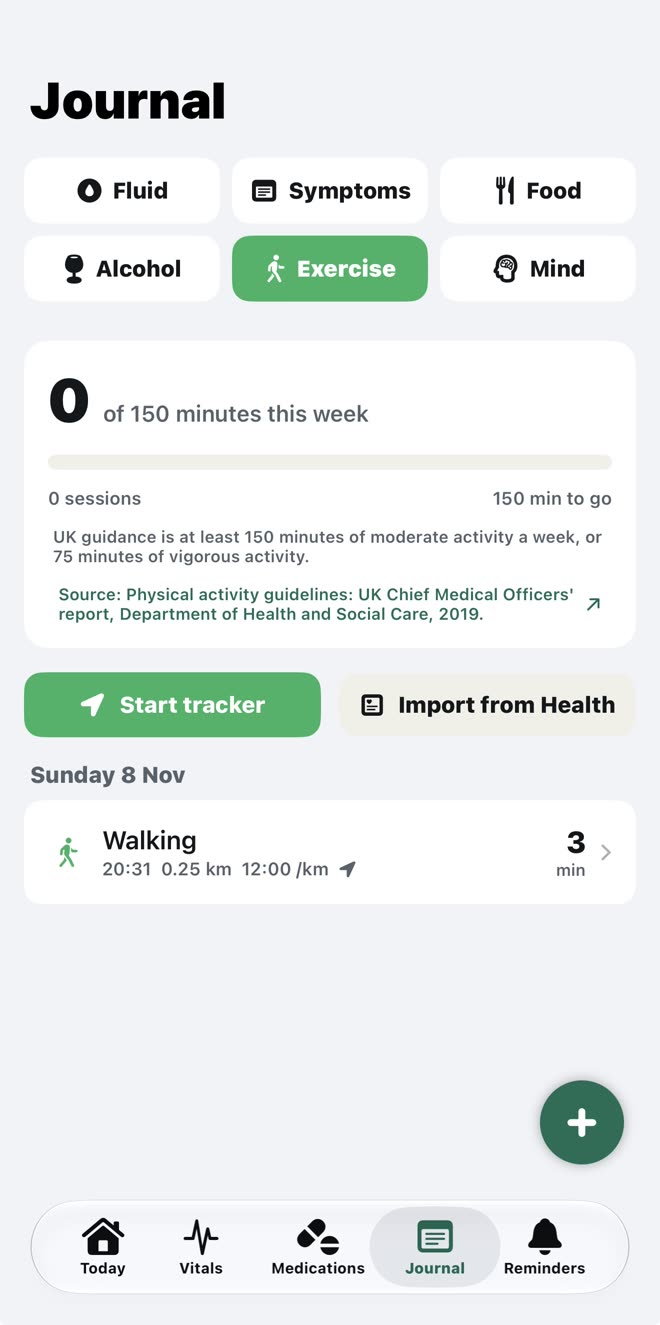
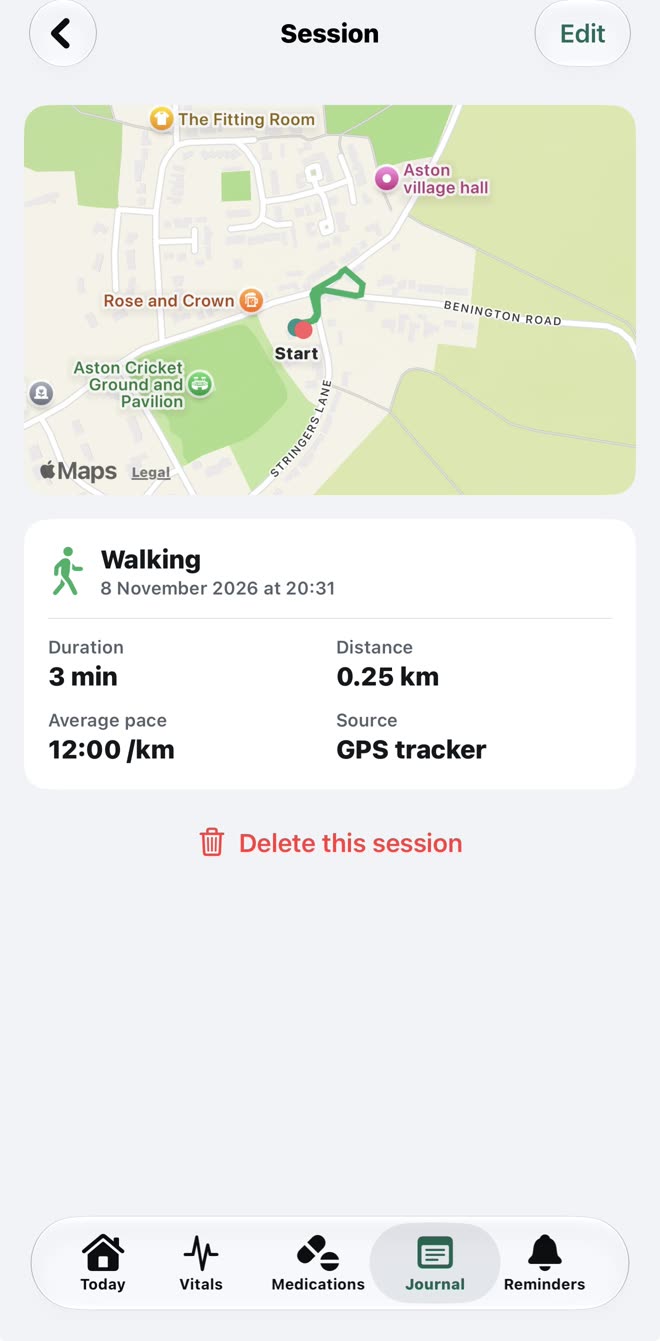
Tap Start tracker, choose walk, run or ride, and the app records distance, current and average pace and the route on a map. It keeps recording with the screen locked, so you can put the phone away. Stop, save, and the session joins your week against the 150 minutes of moderate activity the Chief Medical Officers advise.
Already use a watch? Import your workouts from Apple Health instead. Patient Diary reads them and never writes anything back.
Source: UK Chief Medical Officers' physical activity guidelines, Department of Health and Social Care, 2019.

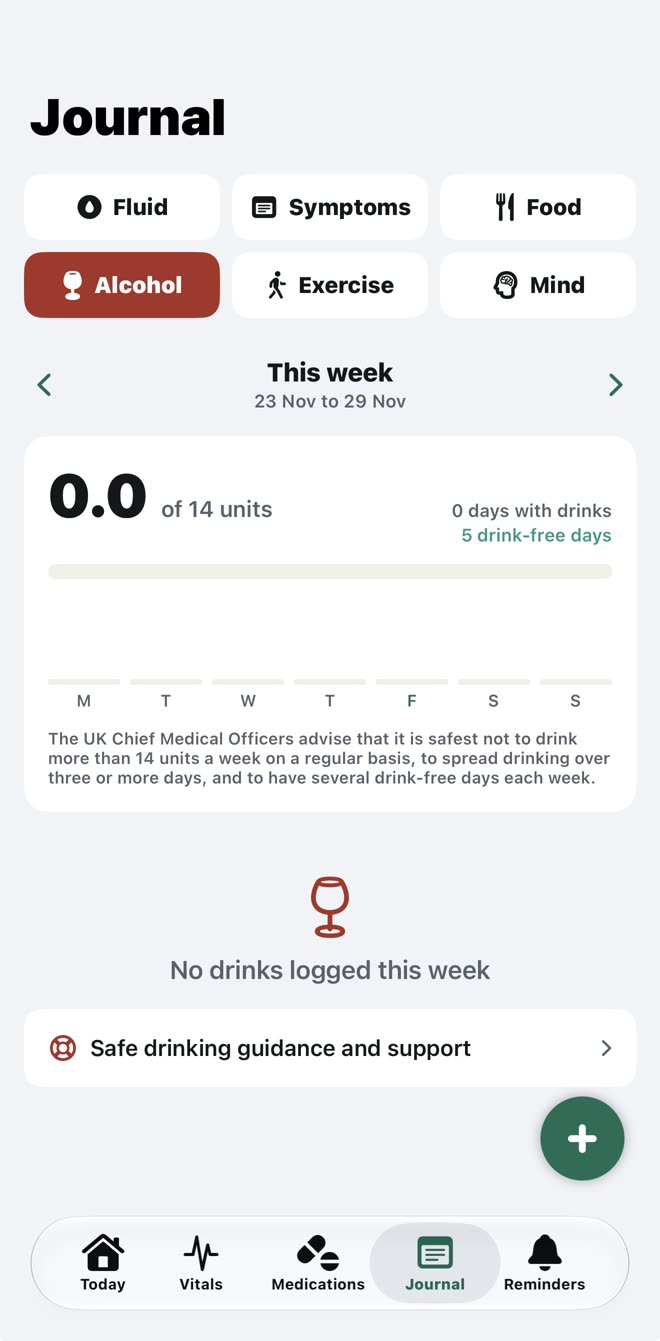
Pick the drink, the glass or bottle size and the strength on the label, and the app does the arithmetic. The week shows your total against the 14 unit guideline, how many days you drank and how many you did not. The advice to spread drinking over three or more days and to keep several drink-free days is quoted as the Chief Medical Officers wrote it.
A Safe drinking screen links to the NHS pages on units and on support, including Drinkline, with the date every link was last checked.
Sources: UK Chief Medical Officers' Low Risk Drinking Guidelines, Department of Health, 2016; NHS, alcohol units and alcohol support.

Type "por" and the app offers porridge, not port. Each suggestion carries energy, protein, potassium, phosphorus and salt for a typical portion, taken from the UK Government's Composition of Foods Integrated Dataset (CoFID 2021). Add what you had it with and how much, and the day's totals build up as you go.
Nutrient figures are reference values for typical foods and estimated portions. The app says so on every screen, because a guide is not a measurement.
Source: McCance and Widdowson's Composition of Foods Integrated Dataset, Public Health England, 2021, Open Government Licence v3.0.

Price
There is no subscription because there is no server to pay for. Your data lives on your phone and in your own iCloud device backup, so the app costs what an app should.
Everything in the app, every future update, on every iPhone signed in to your Apple ID.
Everything you enter is stored on your iPhone. There is no Patient Thread account, no server and no network traffic except the external links you choose to tap. Your phone's own iCloud backup covers the app's data like any other app.
Location is used only between Start and Stop in the exercise tracker, to measure distance and draw the route. The route is saved on the device with the session and is never uploaded. Apple Health is read, never written, and only when you tap Import. Full details in the privacy notice.
Patient Diary is a personal record. It does not give medical advice, calculate a risk or suggest a diagnosis. The blood pressure categories, the alcohol and activity guidelines and the food values are quoted from their published UK sources, which are listed in the app, and your healthcare team's guidance always takes precedence.
Questions
Update from the App Store. Your existing readings, medicines and diary entries are kept, and the four new journals appear in the Journal tab alongside Fluid and Symptoms.
It uses location only while a session is running, and stops the moment you tap Stop. A typical hour's walk costs a few percent, about the same as any running app.
An Android version with all of the same features is built and in preparation for Google Play. This page will link to it when it is live.
From CoFID 2021, the UK Government's food composition table, used under the Open Government Licence v3.0 and credited in the app's About screen. Portion sizes are the app's estimates, not CoFID data, and the app labels them as such.
Only if you give it to them. Export a PDF for any date range and send it yourself. Nothing is shared automatically with anyone, including Patient Thread.
Patient Diary is designed by Dr Christopher Lawrence, a UK consultant nephrologist, and built by Patient Thread Ltd. Questions and suggestions to chris@patientthread.com.